At first glance, a jaguar and a leopard can look almost identical: golden fur, black rosettes, and a watchful expression. But these spotted big cats are separate species with different ranges, proportions, and hunting habits. The easiest jaguar vs leopard comparison begins with their coats, then considers body shape and geography.
Jaguars are muscular cats native to the Americas. Leopards are adaptable hunters found across parts of Africa and Asia. Knowing what each animal is built to do makes identification much easier than simply guessing which one looks bigger.
How to Tell a Jaguar From a Leopard Quickly
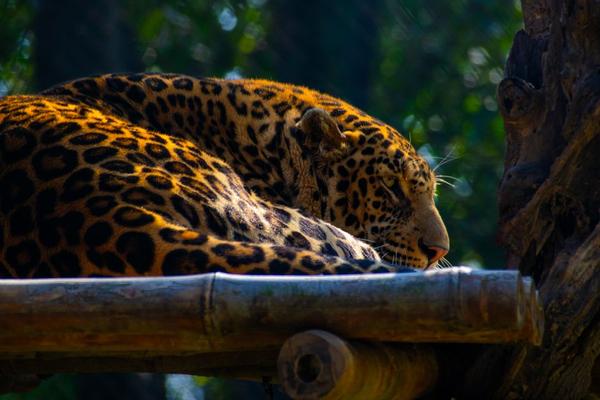
Start with the markings along the animal’s sides. Jaguar rosettes are generally larger, often with one or more small black dots inside. Leopard rosettes usually look smaller and more closely packed, with open centers.
Next, look at the silhouette. Jaguars typically have broad heads, powerful shoulders, and compact bodies. Leopards tend to be leaner, with proportionally longer tails. Finally, check the setting: jaguars live in the Americas, while wild leopards belong to Africa and Asia. These three clues work better together than any single feature.
Jaguar Spots vs Leopard Rosettes
What is a rosette?
Rosettes are irregular dark rings or broken circles that help camouflage both cats among leaves, branches, and shadows. They differ from the mostly solid round spots of a cheetah. On a clear side-view photograph, rosette structure is one of the most useful big cat identification clues.
Jaguar spots often form bold, widely spaced rosettes containing little dark marks. Leopard rosettes are usually smaller, more numerous, and hollow in the middle. Neither animal has identical markings across its entire body: legs and other areas can carry solid spots. Examine several flank rosettes before deciding.
Can both cats be black?
Yes. A “black panther” is not a separate species; the name commonly refers to a melanistic jaguar or leopard. Its coat contains unusually dark pigment, but the underlying rosettes may still appear in strong or angled light. When the markings are hard to see, location and build become more helpful.
Size, Strength, and Body Shape
Jaguars are generally heavier and stockier than leopards, with thick necks, broad skulls, and muscular forequarters. Leopards have comparatively slender frames, narrower heads, and long tails that assist with balance while climbing.
There is substantial variation within each species. Males generally exceed females in size, and local food conditions affect growth. A large leopard can outweigh a small jaguar, so weight alone is not a reliable identifier. The distinction is more about typical proportions than a rigid size cutoff.
The jaguar’s imposing head makes particular sense when you explore jaguar anatomy and the adaptations behind its powerful jaws.
Where Do Jaguars and Leopards Live?
Jaguar range and habitat
Jaguars occur primarily from Mexico through Central America into South America, although their range is fragmented. Important populations live in the Amazon and Brazil’s Pantanal wetlands. They inhabit rainforests, wetlands, woodlands, and some drier environments where suitable prey and cover remain. Rare sightings also occur near the United States–Mexico border.
Leopard range and habitat
Leopard habitat is more geographically varied, spanning parts of sub-Saharan Africa and Asia. Leopards live in savannas, forests, rocky mountains, and some arid landscapes. Their flexibility is impressive, but populations have disappeared from portions of their historical range.
These species do not naturally meet in the wild. A caption placing a jaguar in an African national park or a leopard in the Amazon should be checked carefully. A separate guide to leopard habitats offers a useful look at their remarkably different environments.
Hunting Behavior and Bite Strength
Both are solitary ambush predators that stalk closely before launching a short attack. They take different prey depending on their habitats, so no single hunting scene represents an entire species.
Jaguars have remarkably robust jaws. They are known to bite into the skull or head of some prey and can tackle armored animals such as caimans and turtles. They also hunt mammals including capybaras and peccaries. However, the dramatic skull bite is not used in every attack.
Leopards commonly kill with a bite to the throat or neck. Their prey may include antelope, monkeys, birds, and smaller mammals. In areas with lions or hyenas, they often move kills into trees to keep food away from competitors. That is characteristic behavior, not something every leopard does after every hunt.
Precise internet rankings of bite force in pounds per square inch are often unsupported or based on incomparable estimates. It is more accurate to describe jaguars as especially strong-jawed and leopards as powerful, agile hunters.
Climbing and Swimming
Jaguars are particularly associated with water. They swim across rivers and travel through flooded forests and wetlands; some also hunt aquatic prey. Leopards can swim, but water is generally less central to their reputation and behavior.
Leopards excel in trees. They rest on branches, climb with impressive loads, and use their long tails for balance. Jaguars climb too, so a cat in a tree is not automatically a leopard. Similarly, seeing a spotted cat swim does not prove it is a jaguar. Compare several clues instead of treating either ability as exclusive.
Try This Photo-Identification Test
Imagine a wildlife photograph showing a broad-headed cat with thick shoulders and large rosettes containing central dots. Jaguar is the stronger identification, especially if the picture comes from the Pantanal. Now picture a slimmer cat with tight, open rosettes and a long tail hanging below a tree branch in Kenya. That points toward leopard.
Zoom in on multiple markings rather than one blurry patch. If the image is too dark, distant, or cropped to show useful features, acknowledge the uncertainty. A broader guide to identifying spotted wild cats can help rule out cheetahs and other lookalikes.
Why Both Species Need Protection
Despite their different ranges, jaguars and leopards face habitat destruction, declining prey, and conflict with people over livestock. Conserving connected landscapes and reducing retaliatory killing matter for both. Their adaptability does not make either species immune to population decline.
Frequently Asked Questions
What is the easiest jaguar leopard difference to see?
Look at the side rosettes. Jaguars usually have larger markings with dark spots inside, while leopards usually have smaller, open-centered rosettes.
Is a jaguar bigger than a leopard?
Usually, a jaguar is heavier and more powerfully built. Individual sizes overlap, however, so body proportions are more useful than size alone.
Do jaguars and leopards live in the same places?
No. Jaguars are native to the Americas, while leopards live in Africa and Asia. Their natural wild ranges do not overlap.
Which is better at climbing or swimming?
Leopards are especially accomplished tree climbers, while jaguars are more strongly associated with swimming and wetland habitats. Both species can do both activities.
Final Thoughts
For a dependable jaguar vs leopard identification, combine rosette pattern, silhouette, and geographic range. Broad rosettes with central dots and a compact, heavy build favor jaguar; smaller open rosettes and a leaner body favor leopard. Their different hunting and habitat preferences add context, but no single behavior should decide a difficult identification.