A fresh mound of earth in a prairie can tell a surprisingly lively story. It may mark the work of an American badger, a stocky predator that hunts much of its food below ground. While coyotes patrol open country on long legs, badgers tackle the landscape with powerful shoulders, long claws, and a talent for excavation. These American badger facts explain how that approach shapes the animal’s home, meals, and daily routine.
The American badger, Taxidea taxus, belongs to the weasel family, Mustelidae. It is native to North America and plays a distinctive role in grasslands, where rodents and their tunnels form an underground network of opportunities.
How to Recognize an American Badger
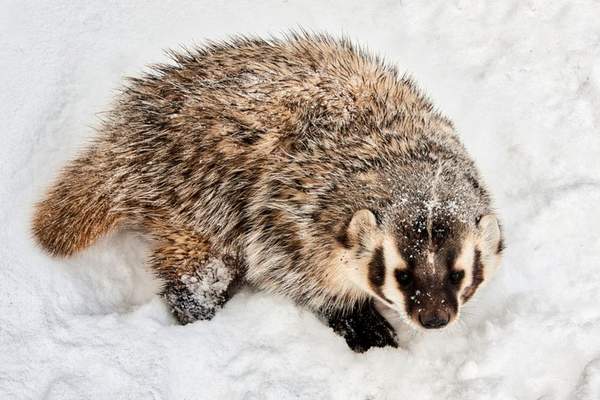
American badgers have broad, low bodies, short legs, and a wedge-shaped head. Their coat appears grayish or brownish because light and dark hairs are mixed together. The face is more striking: dark patches flank a white stripe that runs along the nose toward the back of the head.
Adults vary in size, but Yellowstone National Park describes them as roughly 22–28 inches long and 13–25 pounds. Thick forelimbs and long, curved front claws explain their lifestyle. The compact body can follow prey into tight spaces, while the claws shift soil quickly. Their overall shape is built for digging rather than speed over long distances.
Where American Badgers Live
American badger habitat includes prairies, grasslands, shrublands, agricultural edges, and mountain meadows. Their distribution extends across much of the western and central United States, parts of southern Canada, and into Mexico, although they are uncommon in many local areas.
Open vegetation helps, but soil and food matter just as much. Badgers favor places where they can excavate and where ground squirrels, pocket gophers, prairie dogs, or other burrowing mammals are available. Sandy or loamy ground is often easier to work than hard, rocky soil. At Wind Cave National Park, mixed-grass prairie and prairie dog colonies provide both digging conditions and prey.
A landscape can look like excellent badger country without supporting many badgers. Prey availability, roads, and habitat fragmentation also influence where individuals can live.
Badger Burrows: More Than a Place to Sleep
Badger burrows are not necessarily permanent homes occupied night after night. An American badger may dig to pursue a rodent, rest in another excavation, and use a more sheltered den for raising young. An individual can visit numerous burrows across its home range.
Entrances often appear as broad openings with conspicuous piles of excavated soil. Some are shallow hunting digs; others lead to deeper passages or chambers. A den may offer protection from weather, a daytime refuge, or a place to store food.
Abandoned burrows can benefit other wildlife. The National Park Service notes that burrowing owls, rabbits, skunks, and kit foxes may use excavations left by badgers in suitable habitats. That makes the badger more than a predator: its digging creates shelter for neighbors. This is part of the bigger story of burrowing mammal adaptations.
What Do American Badgers Eat?
The badger diet centers on small mammals, especially species that spend time underground. Pocket gophers, ground squirrels, prairie dogs, voles, mice, and other rodents are frequent prey. Badgers also take rabbits, reptiles, amphibians, insects, and occasionally birds or eggs from ground nests. Plant material can appear in the diet, but this is primarily a carnivorous hunter.
How a Badger Hunts Underground
Rather than waiting beside every hole, a badger can dig directly toward a hidden animal, using strong forelegs and keen senses to locate prey. It may enlarge an existing tunnel or break into a burrow system. Loose earth can fly behind it as the badger advances.
Badgers sometimes hunt near coyotes. Observations show that the two species may exploit different escape routes: a coyote pursues prey above ground while a badger digs toward it below. This association is documented, but not every encounter is deliberate cooperation. The relationship is a vivid example of prairie food webs in action.
American Badger Behavior and Defense
American badger behavior is generally solitary. Adults usually forage and shelter alone except during mating, and mothers temporarily share dens with their offspring. They are often most active after dark, although daylight sightings occur, particularly in quieter places.
In colder weather, badgers may spend extended periods underground and enter short bouts of reduced activity, called torpor. They do not undergo the long, continuous hibernation associated with some mammals.
A threatened badger may hiss, growl, show its teeth, or stand its ground. Its jaws and claws make close contact risky, but it normally avoids people when given space and an escape route. Large predators such as cougars, wolves, and bears can kill adults, while young badgers face additional threats.
Breeding and Raising Young
American badgers generally mate in late summer or early fall, but birth is delayed by an unusual adaptation. After fertilization, embryonic development pauses before implantation in the uterus. Development resumes in winter, allowing young to arrive in spring when conditions may be more favorable.
Litters commonly contain about three young, though one to five is possible. The mother prepares a sheltered den and cares for newborns, which are blind and dependent. As they grow, the young begin leaving the den and learning to forage. By later summer, many disperse to establish their own ranges.
How to Spot Badger Signs Without Disturbing Wildlife
Imagine walking a designated trail through Wyoming grassland and noticing fresh, pale soil beside a wide, low opening. Before assuming a badger made it, look from a safe distance for clues: claw-marked earth, nearby smaller excavations, and rodent activity. A hole alone cannot confirm the species; other mammals dig large burrows too.
Never put a hand into the entrance, approach young, or block the opening for a photograph. Keep dogs leashed and use binoculars if an animal appears. Observing animal tracks in soft soil from the trail can provide context without disturbing the site. Follow park rules and stay on permitted routes.
Frequently Asked Questions
Are American badgers dangerous to humans?
They can defend themselves forcefully if cornered or handled, but generally avoid close contact. Watch from a distance and never attempt to touch or trap one.
Do American badgers live in groups?
No. They are mostly solitary, apart from mating encounters and the bond between a female and her dependent young.
Do badgers use the same burrow every day?
Not necessarily. Many excavations are made while hunting, and an individual may use several resting or shelter burrows throughout its range.
Do American badgers hibernate?
No. They may become less active and remain underground for long stretches in winter, but can emerge and forage when conditions allow.
Why the American Badger Matters
American badgers perform two important ecological jobs: they hunt burrowing prey, and they reshape soil while doing so. Their abandoned dens may shelter other species long after the original excavator moves on. Understanding their habitat, burrows, diet, and behavior reveals how much wildlife activity happens just below our feet.