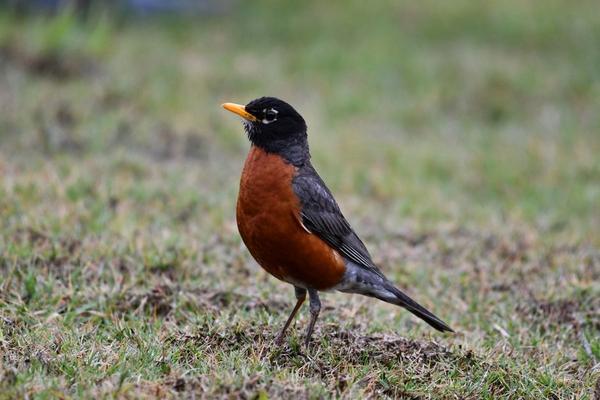
The first bird to catch your eye on a neighborhood lawn may be an American robin. It stands tall, takes several quick steps, pauses, and suddenly pulls an earthworm from the grass. That familiar scene is also a useful identification lesson: color helps, but body shape, sound, and movement make the identification much more reliable. Once you know what to watch for, you can recognize robins even when their orange breasts are hidden.
American Robin Identification at a Glance
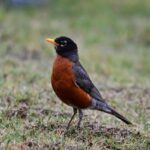
The American robin is a large North American thrush, not a close relative of the smaller European robin. Its most recognizable combination is a rusty orange underside, gray-brown back, long legs, and an upright posture. Adults usually show a yellow bill and pale markings around the eyes.
Look for a fairly long tail, a rounded body, and a head that often appears dark against the orange chest. American robins are typically about 8–11 inches long, making them noticeably larger than many sparrows and most warblers. You can see them in lawns, parks, wooded neighborhoods, and forest clearings across much of the United States.
Key American Robin Field Marks
Orange Breast and Gray Upperparts
An adult’s breast and belly range from warm orange to deep reddish orange. The upperparts are mostly gray or brownish gray, creating a clear contrast. The pale lower belly and undertail area can show when the bird turns or flies away. Don’t reject a robin just because its breast looks muted in shade or winter light.
Face, Bill, and Tail
Check the face when you have a good view. Many adults show broken white arcs around the dark eye rather than one perfectly continuous ring. The bill is generally yellow with a darker tip that varies among individuals. A white-streaked throat may become visible when a bird sings.
The tail is relatively long and dark, with white at the outer corners that can flash in flight. These smaller details are especially useful when the bird is distant or partly concealed by branches.
Male, Female, and Young Robins
Adult males often have blackish heads and richer orange underparts. Females usually look a little paler, with less contrast between head and back, but the sexes overlap enough that color alone is not always decisive. Juveniles look different: their breasts are heavily spotted, their upperparts can appear mottled, and their faces look less cleanly patterned. A spotted young robin accompanying an adult is easy to mistake for another thrush.
How to Recognize the Robin Song
The robin song is a rolling series of clear, flutelike phrases, rising and falling with small pauses between them. Birders sometimes translate its rhythm into words such as “cheerily, cheer up,” but the repeated, musical phrasing matters more than the syllables. Listen at dawn in spring and early summer, when singing males may be perched high in trees or on rooftops.
Robins also give shorter sounds: soft “tuk” or “cuck” notes, sharper alarm calls, and chattering phrases. A quick call from a flock in a winter tree sounds quite different from a full spring song. Listening to several recordings while watching a visible singer is one of the fastest ways to connect the sound with the species.
Robin Behavior: Watch the Ground, Not Just the Trees
A particularly helpful clue is the robin’s stop-and-start feeding pattern. It runs or hops across short grass, freezes, tilts its head, and then pecks or pulls at prey. Contrary to a popular story, robins are understood to find many earthworms visually; the head tilt should not be treated as proof that they are listening for worms underground.
Their food changes with the season. Earthworms, insects, and other invertebrates are especially important during warmer months, while berries and other fruits become prominent in fall and winter. An American robin feeding in a fruiting tree is just as typical as one hunting worms on a lawn.
During breeding season, pairs may carry grass and mud to cup-shaped nests in trees or on sheltered building ledges. The female usually does most nest construction and incubation. A glimpse of blue eggs can be memorable, but egg color by itself is not a reliable way to identify a bird. Give active nests plenty of distance.
Where and When to Look
American robins are widespread across North America, but their local visibility changes through the year. Spring brings conspicuous singing and territorial behavior. In summer, adults often forage on lawns and young spotted birds begin appearing nearby.
In fall and winter, robins can gather in sizable flocks and move between berry-rich trees and sheltered roosts. Some migrate considerable distances; others remain farther north wherever food is available. If robins seem to vanish from your yard in December, check fruiting trees before assuming they have left the region.
American Robin or a Similar Bird?
A varied thrush, found mainly in western forests, also has orange coloring but usually shows a striking dark band across the breast and stronger wing markings. A spotted or eastern towhee has rusty sides, yet its white belly and different body proportions distinguish it from a robin. Smaller bluebirds have blue upperparts rather than the robin’s gray back.
For a difficult sighting, combine three clues: the bird’s overall shape, where its orange plumage appears, and how it moves. That approach works far better than identifying every orange-breasted bird as a robin.
A Five-Minute Backyard Identification Exercise
Find a place overlooking an open lawn with a nearby tree. Watch quietly for five minutes. When a robin arrives, note whether it runs and pauses, how upright it stands, and whether the tail seems long. Then look for the pale eye arcs and yellow bill. If it flies into a tree and sings, match the musical phrases to the bird you just observed.
This simple exercise builds skills you can reuse with other common backyard birds. Learning backyard bird songs and choosing native fruiting plants for birds are worthwhile next steps for anyone hoping to make more sightings at home.
Frequently Asked Questions
How can I identify an American robin quickly?
Look for a fairly large, upright thrush with orange underparts, a gray-brown back, long legs, and a yellowish bill. Its characteristic run-pause feeding style provides an excellent second clue.
Do female American robins have orange breasts?
Yes. Females also have orange or reddish underparts, though they often appear duller than adult males. Lighting, age, and individual variation can make the difference subtle.
Why does a young robin have spots?
Recently fledged robins wear juvenile plumage with dark spots across their breast. As they mature, they replace that spotted appearance with the more familiar orange underside.
Do American robins stay all winter?
Some do. Winter distribution depends on location, weather, and food availability. Robins may spend more time in flocks around fruiting trees and less time on open lawns.
Putting the Clues Together
The best American robin identification begins with the whole bird, not a single feather color. Notice its round body, orange breast, pale eye markings, musical voice, and distinctive ground-feeding rhythm. With a few deliberate observations, one of America’s most familiar birds becomes a dependable reference point for identifying many others.